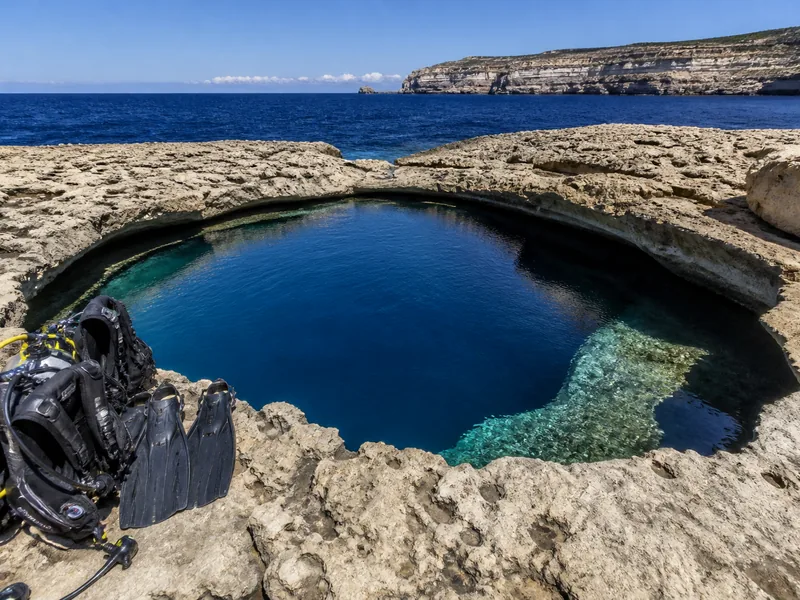
The Blue Hole on Gozo is a natural rock pool and Malta’s most requested shore dive, cut into the reef at Dwejra on the island’s west coast. It suits divers and confident snorkellers on calm days, but it is not a beach, and anyone after sand or easy paddling will be happier at ramla bay or the blue lagoon comino.
What you get here depends first on the sea. The site is not sheltered from the open Mediterranean, so do not enter if there are swells. On flat days it is an unforgettable swim through an archway to the open sea. When there is wave energy on the reef it becomes a place to look at from a safe distance instead. Add crowds to that equation in peak season, because the area is small and can get crowded, and you understand why early morning or late afternoon pays off.
So what is it like underwater. You step down carved rock to a circular pool and drop onto a clean bottom at about 15 m, with an adjoining cave at the same depth. On the seaward wall, the archway to open sea starts around 6 m and extends to about 15 m, and there is a large cave at the bottom of the archway on the opposite side. Just outside the pool, a crack in the wall known as the chimney lets you rise from the mid‑depths to the shallow Coral Gardens and exit over bright rock and weed. Since the Azure Window collapsed in 2017, its ruins lie submerged nearby, creating a plateau around 15 m and new boulder fields with natural swim‑throughs in the mid‑twenties to mid‑thirties metres.
Marine life is Maltese rather than tropical, but lively. Amberjack and blue runner ghost the edge on good days, damselfish hover over the rocks, and morays and octopus find pockets in the limestone. In summer you may see clouds of shrimp. In winter, look in the darker holes for Conger eel. Coral Gardens, next to the hole, sits between a metre and ten metres and is busier for snorkellers than the hole itself.
Getting there is simple if you keep an eye on the signs. If you are driving, follow 'Dwejra/Inland Sea' signs across the plateau to the bay. If you are taking the bus, there is a direct bus 311 (from Victoria) that runs to Dwejra. However you arrive, this is a shore entry and everything you need is on the reef top rather than at a formal beach club. If you are planning the island without a car, build it into a gozo day trip or come over on the ferry and bus, see also our guide on travel to gozo by sea.
Parking and access are straightforward. There is a public car park at the road end, and a larger Dwejra car park with plenty of space to pull up and kit up. From either, it is a short walk over karst to the hole. The entry path is a rough path carved into the stone, with steps carved into rocks dropping towards the water. There is only one water entrance to the pool itself; if it looks busy, give way and take your time.
The walk is over sharp, pitted limestone, which feels fairly difficult with tanks and weights, and merely awkward with snorkel gear. Some people describe the approach as adventurous rather than too strenuous. Either way, rocks can be sharp, and closed‑toe reef shoes or dive boots make the difference between a good day and a bruised one. In all conditions, avoid venturing close to the shore edge if the sea is running.
There are no gates or lifeguards here. Access is free, and you can come year round. For visibility, best visibility is October and November, but you will want a wetsuit in those months. Summer is warmer and better for a long surface interval, but it also brings crowds and more jellyfish days. The hole and the reef are open water, so treat them with respect.
When to skip it. If you arrive and see white water rolling across the outer reef, or feel surge in the pool, save the dive for another day. This is not a sheltered lagoon, and conditions can change quickly with wind direction and swell. If you are travelling with small children or anyone unsteady on their feet, choose mellieha bay or paradise bay instead.
Costs are simple here: there are no entry fees or tickets to pay, and there is nothing to rent on the spot. Bring what you need and plan for a self‑reliant visit.
For divers and confident snorkellers, the specifics are why you came. The Blue Hole bottom sits around 15 m, and you can explore an adjoining cave at the same depth before gliding through the arch to the reef. The chimney is just outside the hole, a relatively easy passage that feels adventurous and exits into Coral Gardens. If you prefer to drop deeper, the collapse of the Azure Window left natural routes in the mid‑twenties to mid‑thirties metres, with a classic swim‑through at about 26 m. Minimum certification to dive the standard route is Open Water Diver, which keeps you within 18 m, and Nitrox is recommended if you plan longer loops on the reef. The site offers routes for all levels, but the Blue Hole itself is exposed, so snorkellers who are not completely confident are better off starting in Coral Gardens and peeking into the pool from the surface.
Safety is about timing and judgment. This is a rocky shore, not a managed entry, and the site is not sheltered. Sea urchins, the odd jellyfish and sharp limestone are the main hazards, plus surge on days with groundswell. Enter and exit slowly, watch your footing, and do not enter if there are swells. Freedivers should take the same conservative view: do not free dive if not trained.
What to bring and wear depends on season and what you plan to do, but a few things are almost universal. Wear sturdy dive boots or reef shoes for the walk and entry. Pack a mask, snorkel and fins if you plan to swim. In October and November, a wetsuit is a must for long sessions, even if the air is warm. Sun protection and water matter more here than at a sandy beach because there is little shade and the rock stores heat.
You are not out in the wilds for services. There are public toilets and showers near the car park, and several restaurants around the parking lot, handy for a post‑dive plate and a cold drink. Bring cash or a card and your own drinking water to avoid an extra walk.
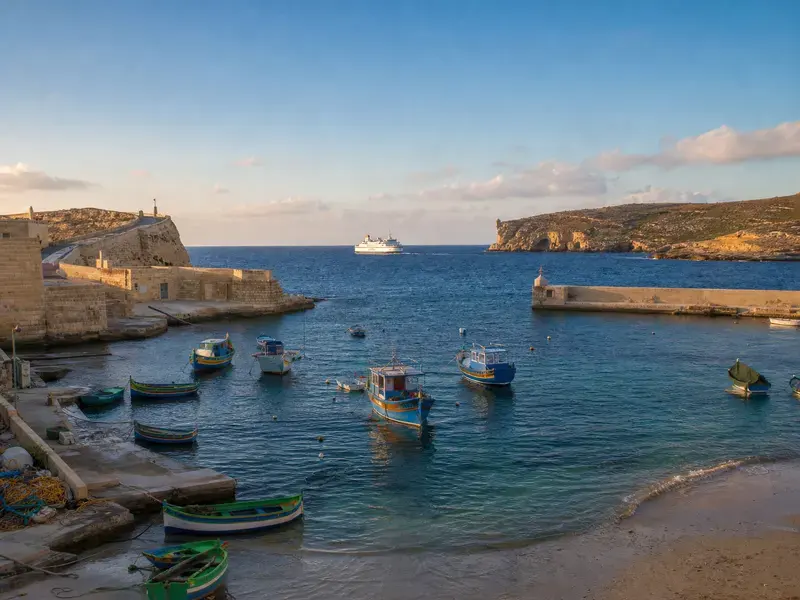
Make time for the other parts of Dwejra while you are here. The Inland Sea is a sheltered basin with a pebbly beach and a small quayside, linked to the outside by a 100 m tunnel used by smaller boats. Short boat trips run from the fishermen on the quayside when the sea is calm. The Dwejra Tower dates to 1652 and is usually open when the flag is flying, and the tiny Chapel of St Anne was built in 1963. Offshore, Fungus Rock has its own lore of a guarded medicinal plant and a primitive cable‑car, and Crocodile Rock is the sea stack that looks like a reptile’s snout on calm days. The bay itself is deep and used as a fair‑weather anchorage by yachts. If you are collecting sea‑edge views, pair Dwejra with the dingli cliffs or the sea caverns at the blue grotto, and divers can compare it with the wreck and reef routes at cirkewwa diving.
What people get wrong here. They expect the Azure Window to be standing, when it became an underwater site in 2017. They arrive on a windy day and still push for a swim because it looks like a pool from above. They forget that the walk in fins and kit is part of the day, and come in flip‑flops. Think of it as a little expedition rather than a beach stop and you will enjoy it more.
Quick answers. Yes, you can do this as a shore dive, and entry via the Blue Hole is the most popular option. Yes, Coral Gardens next door is better for snorkellers. No, there is no shade, so plan your sun protection. And if you only have one calm‑sea day on Gozo, this is the place to spend it.
Common questions
Is the Blue Hole good for beginners?
Underwater, there are routes for all levels, but entry is over rough rock. New divers should go with a local centre and keep to the shallower plan. For snorkelling, the Blue Hole itself is exposed and better left to confident swimmers on calm days; Coral Gardens next door is easier.
Can I visit any time of day?
Yes, but go early or late in summer because the area is small and can get crowded. Avoid any time the sea is moving across the reef.
How deep is the Blue Hole?
The bottom sits around 15 m, with an adjoining cave at the same depth. Beyond the arch, the reef drops to deeper routes for qualified divers.
Are there facilities at Dwejra?
There are public toilets and showers and several restaurants around the parking lot. Bring water and shade anyway, as the rocks get hot and there is little natural shelter.
Is the Azure Window still there?
No, it collapsed in 2017. Its remains now form an underwater dive site with boulders, a plateau around 15 m and new swim‑throughs in the mid‑twenties to mid‑thirties metres.
Last checked: 29 October 2026. Prices, opening hours and timetables change, verify anything time-sensitive before you travel. Photo: Diego Delso, CC BY-SA 4.0.